1:49 min
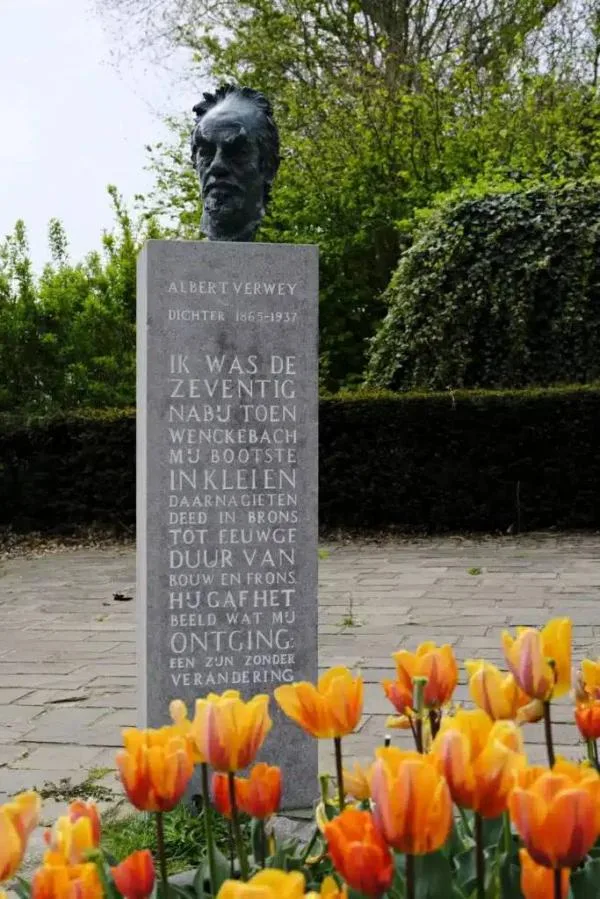
For years, 'Albert Verwey' stood waiting for the tram to Leiden right on this street corner; he was a professor at Leiden University. In addition, he was also a poet, essayist, and translator.
Verwey is one of the most prolific literary figures of the first half of the 20th century. In 1885, he co-founded the literary magazine 'De Nieuwe Gids'. It was a platform for innovative ideas in the fields of literature, politics, society, and science, serving as a counter-voice to the conservative attitudes of the time in which they were living at that moment.
He lived in Noordwijk from 1890 until his death and is buried in the Noordwijk General Cemetery.
This sculpture was created by Oswald Wenckebach. It is a copy; the original is located in the Boymans van Beuningen Museum in Rotterdam. Wenckebach began as a painter, lithographer, etcher, and woodcarver. However, after several years in Greece, he became intrigued by ancient sculpture and mastered the art of sculpting. At the age of 25, he destroyed all his earlier work and continued as a sculptor. He created statues, war memorials, and portraits, was involved in many restorations of old buildings, and designed a large number of medals and coins.
Perhaps his most famous work, 'Monsieur Jacques', stands at the Kröller-Müller Museum in Otterlo and on the Coolsingel in Rotterdam. However, you can encounter his work in public spaces throughout the Netherlands, including in Noordwijk, where he lived and worked extensively.
His poem is engraved on the pedestal:
'I was near seventy
when Wenckenbach molded me in clay
and then cast me in bronze
To eternal duration of build and frown
He gave the image what eluded me
a being without change